Friday, 28 October 2016

The Tragedy of the Commons


It’s not every day you come across an idea first published in the Victorian Era, to be more relevant today and is likely to become even more so as mankind grows. The Tragedy of the Commons was published in an essay by economist William Forster Lloyd in 1833, the ‘commons’ here refers to the common lands and ‘tragedy’ the unregulated grazing upon them that brought their demise.

In a nutshell, it states the incapability of man to see the common good, each individual selfishly overuses a shared resource and collectively, they end up depleting it.

Here's the example the original essay used:
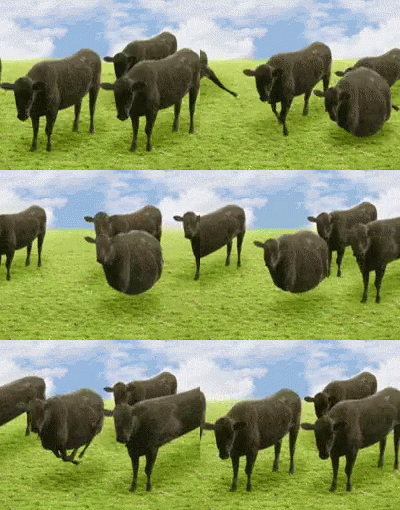
Suppose a number of cattle herders share the same piece of land and they are each allowed a select number of cows to let graze upon the land. Now if one of them lets more than their allotted number of cows graze, to increase his profits, overgrazing will likely result as more cattle herders will follow suit. This overexploitation of the land will render it barren thus depleting the resource.

Although it was written way back in 1833, it wasn’t until ecologist Garrett Hardin’s 1968 article that the idea gained recognition. The concept of Sustainable Development further helped bring this matter into limelight. Traditionally an economic theory, it has been used to study fields as diverse as politics and evolutionary psychology.

The example above, which though works literally, is meant to be metaphorical and demonstrates the effect the ever-growing population has on our finite resources. This paragraph from Wikipedia puts it into way better words than I could come up with:
“The metaphor illustrates the argument that free access and unrestricted demand for a finite resource ultimately reduces the resource through over-exploitation, temporarily or permanently. This occurs because the benefits of exploitation accrue to individuals or groups, each of whom is motivated to maximize use of the resource to the point in which they become reliant on it, while the costs of the exploitation are borne by all those to whom the resource is available (which may be a wider class of individuals than those who are exploiting it). This, in turn, causes demand for the resource to increase, which causes the problem to snowball until the resource collapses (even if it retains a capacity to recover). The rate at which depletion of the resource is realized depends primarily on three factors: the number of users wanting to consume the common in question, the consumptiveness of their uses, and the relative robustness of the common.”

To contrast the above, here are some real life examples of The Tragedy of the Commons in action.

Saturday, 22 October 2016

The Elusive Nature of Memory


Our memory is something we heavily rely on, whether it be routine tasks like writing or recognizing a distant relative, it all relies on our memories, one kind or the other. For something so significant to us, it’s no wonder we might see our memories as infallible. In reality, we couldn’t be further from the truth.

Our memories, even long term ones, are constantly evolving and often amend themselves in view of new information pertaining to past events. Memories can frequently get altered and sometimes completely false memories can develop, in a phenomenon known as Confabulation. This fact is the most sought after rational explanation of the so-called Mandela Effect. Extensive evaluation of the Mandela Effect can be read on the self-titled article on this website.

An interesting feature of our memories are how we recollect them years after the events that etched them. Memories tend to curve either towards the negative experiences or positive depending on one’s age. Namely, the Negativity Bias and the Positivity Bias, younger adults are more susceptible to the former while people aged 60 or above generally experience the latter. This paper is an excellent read if you’re interested in the topic in detail.
But this should not be confused with Rosy Retrospection, which is a phenomenon where events seem more favourable in retrospect than when they actually occurred. In the Journal of Experimental Social Psychology, cyclists were surveyed before, during and after a three-week bicycle tour of California. Many told stories of excessive rain, physical exhaustion and unamusing companions. However, retrospective accounts were considerably rosier.

While we’re talking of retrospective memory biases, the Hindsight Bias is a worthy mention. Also known as creeping determinism, it is when people view the outcomes of an event as predictable after they have occurred, even though they had no tangible evidence to predict them. The knew-it-all-along effect as it’s informally called can cause memory distortions similar to the phenomenon of Confabulation discussed above. It is a real problem in situations where precise recollections are essential.The ability to analyse, perceive and interpret experimental studies can be impaired by this phenomenon. Judiciary systems can also be impaired when relying on eyewitness testimonies.

To provide a perspective upon how our cognition is affected by changing technology, let’s discuss the aptly named Google Effect or digital amnesia. People hardly remember information that is easily accessible online. With the ever-expanding internet essentially becoming an extension of our brain, maybe it’s not a bad thing after all.

While reading about the above cognitive and memory biases might have been amusing, the fun
runs out when we discover our own blind spots. We might tend to think that we are impervious to these biases and what we remember is the objective truth, but we couldn’t be more wrong. This view of ourselves as being unbiased is called the Bias Blind Spot and is a true view of ourselves through the looking glass. We might actively know of the fallacies in our perceptions, but that isn’t going to stop them from affecting us.

Tuesday, 18 October 2016

The Automation Paradox


Researching for this particular post was interesting, though there exists a general consensus on what The Automation Paradox is, regardless there are articles which talk about some pretty different ideas under the same name.
  •  This article from The Atlantic uses the term to describe the counter intuitive effect automation has had on employment rates.
  • Vanessa Hill from Braincraft defines it as "The more automated machines are, the less we rely on our own skills. But instead of relying less on automation to improve our skills, we instead rely even more on automation." Or, "In order for automation to exist, there must be manual control. But the more manual control there is, the more automation there will be."
  • The most agreed upon definition of the idea seems to be from John Kaufman’s The Personal MBA, which reads“The Paradox of Automation says that the more efficient the automated system, the more crucial the human contribution of the operators. Humans are less involved, but their involvement becomes more critical.”

    If an automated system has an error, it will multiply that error until it’s fixed or shut down. This is where human operators come in.

    Efficient Automation makes humans more important, not less.


All the above are thought provoking notions indeed and tap into one of the most fundamental fears of the modern man, to be overtaken by machines. Fears of losing jobs to technology not only applies to blue collar jobs, but has also invaded professionals of various fields, as the article mentioned above argues. But this has not led to massive unemployment. In the legal industry, for example the ease in processing has led to cheaper costs of individual cases and demands have increased, which actually caused growth in employment rates in the sector. This is also true for banking and financial services and almost every industry which underwent automation. While this is not true for all fields, as some jobs have become obsolete with the advent of technology, it is still a comforting find.

The matters are not so soothing when we talk about John Kaufman’s idea of the automation paradox, the grimmest example of it can be traced back to the shocking crash of Air France 447, where the auto pilot disengaged due to a faulty pressure probe. A faulty maneuver by the co-pilot caused the plane to stall and neither the pilot nor the co-pilot had a clue as to what was happening, the plane crashed into the Atlantic in a matter of minutes killing everyone aboard. With self-driving cars just around the corner, we need to ask ourselves what kind of effects automation of such large scales might have on future generations. Automation in planes have increased passengers’ safety manifold, the likelihood of dying in a plane crash are close to one in a million. But incidents like these make us question their capabilities. The need for human intervention in situations like these are vital, but humans, with their extensive reliance on technology have rendered themselves useless. Our ever increasing integration of technology has improved our lives to a great extent, and has made learning certain skillsets optional, if not totally impractical. This has caused us to be at the mercy of technology and any failure in it could have catastrophic consequences.


Monday, 17 October 2016

Baader Meinhof Phenomenon and Apophenia


The Baader Meinhof phenomenon,recency illusion,frequency illusion,this particular phenomenon goes by a lot of names.It's a nifty little illusion that most of us encounter on a daily basis,in fact since you have read about this,expect to see this word pop up in the near future.Seeing or hearing things that we recently encountered is one of the many cognitive biases we experience all thanks to our brains constantly trying to decipher new information and find new patterns in everything.

Some even argue coincidences themselves are a result of our flawed perception of reality.One may say Baader Meinhof Phenomenon and other coincidental events are a special case of selective attention.

The brains awesome power to decipher patterns in random data is apparent in certain other phenomena we experience daily:
  • It's the reason we see faces in seemingly random things,an effect we know as Pareidolia.
  • Gambler's fallacy,also known as The Monte Carlo fallcy is the belief that if something happens more frequently,the chances of the same event occurring in the future are lessened.
  • The famous 27 club and 23 enigma are also famous examples
All of the above are examples of Apophenia, the spontaneous perception of connections and meaningfulness of unrelated phenomena.

Cognitive biases are one of the most interesting things to study,our brains control the very nature of our reality and how we perceive it.Even though we actively know about these effects,we can't help but be affected by them.

Sunday, 16 October 2016

The Mandela Effect


The Mandela Effect,first described online in 2010, by Fiona Broome described an experience at a convention called Dragon Con, where she discovered that others had a false memory similar to hers, which was that Nelson Mandela had died during his imprisonment in the 1980s.This is where the phenomenon gets its name from.The reason this idea took off is because a large number of people collectively remember something differently. Since it's inception,several other nondescript things have been pointed out by its subreddit, the Bernstain Bears, the Ford logo, Looney Tunes among the most popular.
The explanation for this phenomenon has ranged from sceptical views upon memory formation to conspiracy theories involving the Large Hadron Collider. 

Neurologists and psychiatrics argue that memory isn't reliable and unlike a cassette tape, one cannot replay past events in perfect detail, instead memory is constructive and the brain constantly looks for clues to fill in the gaps in our memory subconsciously. For example, people might have heard about Nelson Mandela's death and combined it with their old memory of Nelson Mandela's imprisonment and their brain fabricated them onto a single false memory. 
This extract from an article debunking the Mandela Effect puts it nicely:
"The term it fits most with is “confabulation” which is a disturbance of memory which produces fabricated, distorted, or misinterpreted memories about the world, without the explicit or conscious intention to deceive others. People who confabulate in this way produce incorrect memories about the most trivial details (as seen with most Mandela Effects) but range up to more complex fabrications as well. They are generally extremely confident in their recollections and will typically resist any contradictory evidence."

The conspiracy theories involving the Large Hadron Collider typically involve the LHC supposedly destroying parallel universes or merging them with our time stream. The claim that the LHC is causing this shift in time streams is based around the fact that the Mandela Effect was first reported around the time the Large Hadron Collider was first operational.While this is true,the explanation is fairly simple. The term "Mandela Effect" didn't exist before, there have been several events of collective recollection of false memories in the past, some even garnering some serious publicity. 

Keeping scepticism aside, what if this effect were true? Parallel universes, although a staple of the genre of science fiction isn't ruled out in theoretical physics. The problem with Mandela Effect, is that if the effect were true, it would only exist in the mind of the person experiencing it.Analogous the Cassandra complex, the person would have nothing tangible to prove their claims. 

In conclusion, this phenomenon is a pretty interesting one and only goes to show how creative the human mind can be, to conceive an idea such as this, maybe just to avoid admitting it's error or perhaps it genuinely recollects memories from a different time stream.