It’s not every day you come across an idea first published
in the Victorian Era, to be more relevant today and is likely to become even
more so as mankind grows. The Tragedy of the Commons was published in an essay
by economist William Forster Lloyd in 1833, the ‘commons’ here refers to the
common lands and ‘tragedy’ the unregulated grazing upon them that brought their
demise.
In a nutshell, it states the incapability of man to see the
common good, each individual selfishly overuses a shared resource and collectively,
they end up depleting it.
Here's the example the original essay used:
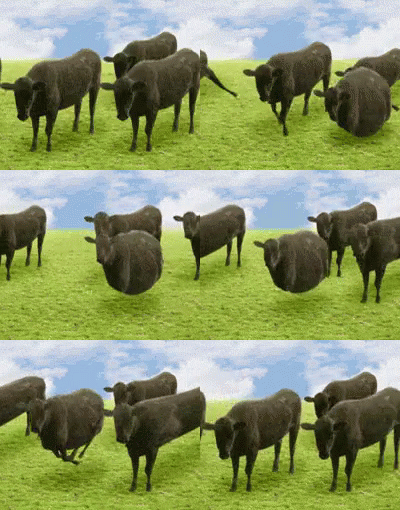
Suppose a number of cattle herders share the same piece of
land and they are each allowed a select number of cows to let graze upon the
land. Now if one of them lets more than their allotted number of cows graze, to
increase his profits, overgrazing will likely result as more cattle herders
will follow suit. This overexploitation of the land will render it barren thus
depleting the resource.
Although it was written way back in 1833, it wasn’t until ecologist Garrett Hardin’s 1968 article that the idea gained recognition. The concept of Sustainable Development further helped bring this matter into limelight. Traditionally an economic theory, it has been used to study fields as diverse as politics and evolutionary psychology.
The example above, which though works literally, is meant to be
metaphorical and demonstrates the effect the ever-growing population has on our
finite resources. This paragraph from Wikipedia puts it into way better words
than I could come up with:
“The metaphor illustrates the argument that free access and unrestricted demand for a finite resource ultimately reduces the resource through over-exploitation, temporarily or permanently. This occurs because the benefits of exploitation accrue to individuals or groups, each of whom is motivated to maximize use of the resource to the point in which they become reliant on it, while the costs of the exploitation are borne by all those to whom the resource is available (which may be a wider class of individuals than those who are exploiting it). This, in turn, causes demand for the resource to increase, which causes the problem to snowball until the resource collapses (even if it retains a capacity to recover). The rate at which depletion of the resource is realized depends primarily on three factors: the number of users wanting to consume the common in question, the consumptiveness of their uses, and the relative robustness of the common.”
“The metaphor illustrates the argument that free access and unrestricted demand for a finite resource ultimately reduces the resource through over-exploitation, temporarily or permanently. This occurs because the benefits of exploitation accrue to individuals or groups, each of whom is motivated to maximize use of the resource to the point in which they become reliant on it, while the costs of the exploitation are borne by all those to whom the resource is available (which may be a wider class of individuals than those who are exploiting it). This, in turn, causes demand for the resource to increase, which causes the problem to snowball until the resource collapses (even if it retains a capacity to recover). The rate at which depletion of the resource is realized depends primarily on three factors: the number of users wanting to consume the common in question, the consumptiveness of their uses, and the relative robustness of the common.”
To contrast the above, here are some real life examples of
The Tragedy of the Commons in action.

No comments:
Post a Comment